Linked List : gfg and other selected Ques
find nth position from last:
1 2 3 4 5 6 7 8 9 10 11 12 13 14 15 16 17 18 19 21 22 23 24 25
e.g 4th pos from last=> using A.P. an from last= L+(n-1)d => L+(n-1)(-1) => L-n+1
25-4+1 => 22
n’th node from the end of a Linked List
using above concept:
// check if value of n is not
// more than length of the linked list
if (len < n) return;
Node* temp = head;
// get the (len-n+1)th node from the beginning
for (i = 1; i < len - n + 1; i++)
temp = temp->next;
cout << temp->data;
using recursion:
void printNthFromLast( Node* head, int n)
{
int i = 0;
if (head == NULL)
return;
printNthFromLast(head->next, n);
// ++i recursion ke baad use krne se yah last me jahan recursion
// pahuncha udhar se increment n times for nth pos, yani bottom to up
if (++i == n)
cout<<head->data;
}
Two Pointer approach: best and imp

//Function to find the data of nth node from the end of a linked list.
int getNthFromLast(struct Node *head, int n)
{
struct Node* slow=head;
struct Node* fast=head;
for(int i=0;i<n;i++){
if(fast) fast=fast->next;
else return -1;
}
while(fast){
fast=fast->next;
slow=slow->next;
}
return slow->data;
}
Find the middle of a given linked list:similiar to above ques(my first placement interview ques)
worst Approch: Traverse the whole linked list and count the no. of nodes. Now traverse the list again till count/2 and return the node at count/2.
Best Approch: two pointer approach
Traverse linked list using two pointers. Move one pointer by one and the other pointers by two. When the fast pointer reaches the end slow pointer will reach the middle of the linked list.
int getMiddle(Node *head)
{
Node* slow=head;
Node* fast=head;
while(fast->next){
if(fast->next->next) fast=fast->next->next;
else fast=fast->next; //when fast reach at node before last
slow=slow->next;
}
return slow->data;
}
Detect loop in a linked list
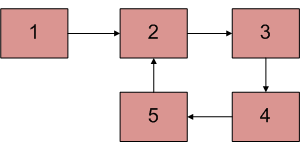
bool detectLoop(struct Node* head)
{
unordered_set<Node*> s;
while (head) {
// If this node is already present
// in hashmap it means there is a cycle
// (Because you we encountering the
// node for the second time).
if (s.find(head) != s.end())
return true;
// If we are seeing the node for
// the first time, insert it in hash
s.insert(head);
head = head->next;
}
return false;
}
two pointer approach: Floyd’s Cycle-Finding Algorithm
- Move one pointer(slow_p) by one and another pointer(fast_p) by two.
- If these pointers meet at the same node then there is a loop. If pointers do not meet then linked list doesn’t have a loop.
bool detectLoop(Node* head)
{
Node* slow=head;
Node* fast=head;
while(fast&&fast->next){
fast=fast->next->next;
slow=slow->next;
if(slow==fast) return true;
}
return false;
}
remove loop in Linked List:

void detectAndRemoveLoop(Node* head)
{
// If list is empty or has only one node
// without loop
if (head == NULL || head->next == NULL)
return;
Node *slow = head, *fast = head;
// Move slow and fast 1 and 2 steps
// ahead respectively.
slow = slow->next;
fast = fast->next->next;
// Search for loop using slow and
// fast pointers
while (fast && fast->next) {
if (slow == fast)
break;
slow = slow->next;
fast = fast->next->next;
}
/* If loop exists */
if (slow == fast)
{
slow = head;
// this check is needed when slow
// and fast both meet at the head of the LL
// eg: 1->2->3->4->5 and then
// 5->next = 1 i.e the head of the LL
if(slow == fast) {
while(fast->next != slow) fast = fast->next;
}
else {
while (slow->next != fast->next) {
slow = slow->next;
fast = fast->next;
}
}
/* since fast->next is the looping point */
fast->next = NULL; /* remove loop */
}
}
check if a singly linked list is palindrome
stack approach: e.g list is 1 2 3 4 5
stack also becomes top to bottom 5 4 3 2 1 bcz 1 pushed first => now match
bool isPalin(Node* head){
// Temp pointer
Node* slow= head;
// Declare a stack
stack <int> s;
// Push all elements of the list
// to the stack
while(slow != NULL){
s.push(slow->data);
// Move ahead
slow = slow->ptr;
}
// Iterate in the list again and
// check by popping from the stack
while(head != NULL ){
// Get the top most element
int i=s.top();
// Pop the element
s.pop();
// Check if data is not
// same as popped element
if(head -> data != i){
return false;
}
// Move ahead
head=head->ptr;
}
return true;
}
also here in M4 is map solution
reverse Linked List using Recursion:

Node* revList(Node* head){
if(!head || !head->next) return head;
Node* roL=revList(head->next);
Node* nxt=head->next;
nxt->next=head;
head->next=NULL;
return roL;
}
revList using stack: Easy
Node* revList(Node* head){
stack<Node*> st;
Node* tmp=head;
while(tmp->next){ // tmp->next isliye taki loop ke baad tmp end me pahunch jaye
st.push(tmp);
tmp=tmp->next;
}
//now tmp reach at end
head=tmp;
while(!st.empty()){
tmp->next=st.top();
tmp=tmp->next;
st.pop();
}
tmp->next=NULL;
return head;
}
Remove duplicates from a sorted linked list
For example if the linked list is 11->11->11->21->43->43->60 then removeDuplicates() should convert the list to 11->21->43->60.
void removeDuplicates(struct Node* head)
{
struct Node* curr=head;
struct Node* nxt=NULL;
while(curr->next){//traverse till end
nxt=curr->next;
if(curr->data==nxt->data){
nxt=nxt->next;
free(curr->next);
curr->next=nxt;
continue;
}
curr=curr->next;
}
}
Remove duplicates from unsorted linked list
For example if the linked list is 12->11->12->21->41->43->21 then removeDuplicates() should convert the list to 12->11->21->41->43.
Add 1 to a number represented as linked list
Input:
LinkedList: 4->5->6
Output: 457
Input:
LinkedList: 4->5->9
Output: 460Input:
LinkedList: 9->9->9
Output: 1000it is also a application of revList Node* revList(Node* head){
if(!head) return NULL;
stack<Node*> st;
Node* tmp=head;
while(tmp->next){
st.push(tmp);
tmp=tmp->next;
}
// now tmp at end
head=tmp;
while(!st.empty()){
tmp->next=st.top();
tmp=tmp->next;
st.pop();
}
tmp->next=NULL;
return head;
}
Node* addOne(Node *head)
{
head=revList(head);
Node* tmp=head;
Node* prevTotmp;
while(tmp&&tmp->data==9){
tmp->data=0;
prevTotmp=tmp;
tmp=tmp->next;
}
if(tmp) tmp->data=(tmp->data)+1;
if(!tmp){
Node* newNode=new Node(1);
newNode->data=1;
newNode->next=NULL;
prevTotmp->next=newNode;
}
head=revList(head);
return head;
}
here is the gfg best sol
struct Node* addTwoLists(struct Node* f_head, struct Node* s_head)
{
f_head=revList(f_head);
s_head=revList(s_head);
struct Node* tmp1=f_head;
struct Node* tmp2=s_head;
struct Node* prev;
int sum=0;
int carry=0;
struct Node* head_to_return=new Node(0);
struct Node* tmp=head_to_return;
while(tmp1&&tmp2){
struct Node* newNode=new Node(0);
int sum=tmp1->data+tmp2->data;
if(carry){
sum+=carry;
carry=0;
}
if(sum>9){
carry=sum/10;
sum=sum%10;
}
tmp->data=sum;
tmp->next=newNode;
prev=tmp;
tmp=tmp->next;
tmp1=tmp1->next;
tmp2=tmp2->next;
}
// both list are of equal length
if(!tmp1 && !tmp2){
// add only whwen carry left
if(carry){
tmp->data=carry;
carry=0;
}
}
while(tmp1){
struct Node* newNode=new Node(0);
int sum=tmp1->data;
if(carry){
sum+=carry;
carry=0;
}
if(sum>9){
carry=sum/10;
sum=sum%10;
}
tmp->data=sum;
tmp->next=newNode;
prev=tmp;
tmp=tmp->next;
tmp1=tmp1->next;
}
while(tmp2){
struct Node* newNode=new Node(0);
int sum=tmp2->data;
if(carry){
sum+=carry;
carry=0;
}
if(sum>9){
carry=sum/10;
sum=sum%10;
}
tmp->data=sum;
tmp->next=newNode;
prev=tmp;
tmp=tmp->next;
tmp2=tmp2->next;
}
// add only whwen carry left
if(carry){
tmp->data=carry;
carry=0;
}
if(tmp->data==0){
free(tmp);
prev->next=NULL;
}
head_to_return=revList(head_to_return);
return head_to_return;
}
Intersection Point in Y Shapped Linked Lists:

int intersectPoint(Node* head1, Node* head2)
{
Node* tmp1=head1;
Node* tmp2=head2;
//if one of them is NULL
if(!tmp1 || !tmp2) return -1;
while(tmp1!=tmp2){ //if here is intersection, end loop
tmp1=tmp1->next;
tmp2=tmp2->next;
if(tmp1==tmp2){ // if here is intersection, return
return tmp1->data;
}
//if one of them becomes NULL, move to another head(complexity purpose)
if(!tmp1) tmp1=head2;
if(!tmp2) tmp2=head1;
}
// if loop end , and not return
return tmp1->data;
}
merge sort in arr:
void merge(int* arr,int l,int mid,int r){
int tmp[r-l+1]; // e.g. total ele from 2 to 7 is 6 (7-2+1)
int i=l,j=mid+1;// second arr start from mid+1 isliye j=mid+1
int k=0;
while(i<=mid && j<=r){
if(arr[i]==arr[j]){
// tricky jb equal tb dono ko rkhna hoga bhai
tmp[k++]=arr[i++];
tmp[k++]=arr[j++];
}else if(arr[i]<arr[j]){
tmp[k++]=arr[i++];
}else{
tmp[k++]=arr[j++];
}
}
while(i<=mid){
tmp[k++]=arr[i++];
}
while(j<=r){
tmp[k++]=arr[j++];
}
// store tmp ele to arr
for(int i=l;i<=r;i++) {
arr[i]=tmp[i-l];
// cout<<arr[i]<<" ";
}
}
void mergeSort(int* arr,int l,int r){
if(l>=r) return;
int mid=(l+r)/2;
// split in two parts
mergeSort(arr,l,mid);
mergeSort(arr,mid+1,r);
// merge sorted parts
merge(arr,l,mid,r);
}
------


Comments
Post a Comment